ADHD and Interrupted Reading: Leave Yourself a Way Back
A practical return-to-reading card for work: keep the source, question, stopping point and next action together when messages or meetings interrupt a document.
You were halfway through a document, answered a message, and came back to a page that looked familiar without remembering what you were trying to find. Starting again is an option, but it does not have to be the default.
Before switching tasks, leave a small return card: the document, your question, the last checked passage and the next action. This is a practical reading experiment for an interruptible workday, not a treatment for ADHD or a claim that every interruption can be prevented.
The NHS’s information on adult ADHD describes possible difficulties with distraction, organization and finishing tasks. It also lists workplace support such as written instructions and help structuring work. Those are broader supports; the specific card below is our suggested way to apply a visible structure to one reading task.
A bookmark saves a location, not your unfinished question
A browser tab or highlighted sentence can tell you where you stopped. It may not tell you whether you were looking for a delivery date, checking a definition or deciding between two proposals.
For a short interruption, a sentence in an existing work note is enough. You do not need another productivity app or an elaborate reading journal.
Copy this template:
READING RETURN CARD
Source and version:
Question I am answering:
Last passage I checked:
What I know so far:
Next small action:
Unresolved question, if any:
Put a link in the source field if you can. For a changing document, include the date or version so a later revision does not silently replace the material you were checking.
Work through one interruption
Here is an invented example. You are reading a proposal for a website migration when a colleague calls about another project.
Your card might say:
Source and version: Migration proposal, revision 3, 14 October
Question: Can the help center move before the main website?
Last checked: Page 6, “Content dependencies,” second paragraph
Known so far: The proposal separates hosting, but login is shared.
Next action: Read “Authentication” on page 9 for release dependencies.
Unresolved: Does the quoted price include migrating redirects?
Notice that “read page nine” is more useful than “finish proposal.” It tells your returning self how to restart without pretending the entire task is small.
After the call, open the card before opening chat. Read the last checked passage and the next relevant section. If the proposal changed while you were away, inspect the changes before continuing with your old conclusion.
This example has not been tested as a productivity intervention. Its value is that the unfinished work is explicit and easy to inspect.
Decide whether you need to switch now
Sometimes you must respond immediately. Sometimes a notification can wait until the current paragraph ends. Decide on that distinction before the reading session, particularly if your role has an urgent support or on-call responsibility.
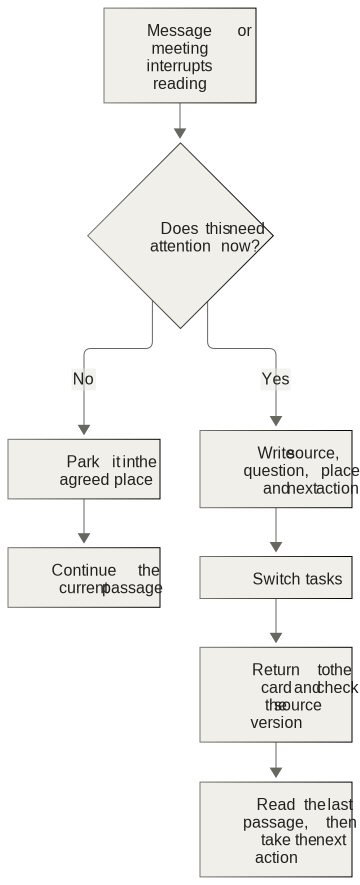
The W3C accessibility guidance on interruptions explains why allowing users to postpone non-emergency updates matters. It is guidance for web content, not proof of a particular workplace schedule. The practical adaptation is to configure nonessential alerts where your job permits and agree how genuinely urgent messages reach you.
When you come back and still cannot follow it
Do not keep rereading the same paragraph without changing the question. Work out what is missing.
If a term is unfamiliar, write down the term and find its definition. If the document assumes a decision you have not seen, ask for that context. If it is simply a bad moment for dense reading, leave the card complete and agree a realistic return time rather than relying on memory.
For repeated interruptions, a protected reading period may be more useful than a better note. Ask for something concrete: “I need to review the proposal before the 15:00 decision. Can nonurgent questions wait until 14:30?” A support role may need a different arrangement, such as shared coverage.
If reading and work remain substantially difficult, a self-made workflow is not the whole support plan. The NHS page explains how to seek appropriate help for ADHD affecting work or other parts of life.
If you listen while reading, save the text location too
An audio timestamp is useful inside the same recording. A heading and a few opening words are more portable when you return through another app or a changed document.
Mira Reader pairs spoken text with word-synced highlighting in its web Reader and private Chrome extension. That makes the visible passage part of the listening experience. It does not mean Mira creates this return card automatically or restores every interrupted work session. The word-highlighting page explains the reading feature; beta access is separate.
Try the card for one recurring document this week. Afterwards, ask a narrow question: did the note contain enough information to take the next step? If not, improve that field. You do not need to measure every minute or turn a useful aid into another task to maintain.